
When a homeowner calls Triton about reverse osmosis drinking water, the first thing I do is ask questions — not answer them. Because before I recommend any water treatment system, I want to understand what’s actually bothering you about your current water. What do you taste? What do you smell? What are you worried might be in it? Are you on city water or a private well?
The answers change the recommendation completely. Sometimes reverse osmosis is exactly the right solution. Sometimes a simpler filter does the job just as well at a fraction of the cost. My goal is to give you the system that makes you happiest long term — not the most expensive option on the shelf.
I’m Aron Oretan — a Licensed Red Seal Plumber and Steamfitter with 26 years in the trade and 16 years running Triton Home Service in London Ontario. Here’s what you need to know about reverse osmosis drinking water before you make any decisions.
A standard carbon filter removes chlorine, sediment, and some contaminants. It improves taste and reduces odour. For many London Ontario homeowners on city water, that’s enough.
Reverse osmosis goes further. An RO system forces water through a semi-permeable membrane that filters out contaminants at the molecular level — including lead, nitrates, fluoride, dissolved solids, bacteria, and most other impurities. As a result, what comes out the other side is exceptionally pure water.
However that purity comes with a trade-off. RO systems filter out just about everything — including naturally occurring minerals like calcium and magnesium. So the water is clean but it’s also stripped of the minerals that give water its taste and that your body uses. Furthermore, RO systems produce water slowly and lose pressure in the process. Depending on your installation, you may need a booster pump to get adequate flow.
That’s why the conversation about what you actually want from your water matters before we talk about systems.
The honest answer is — it depends on what’s driving the question.
If you’re on London city water and your main concern is taste and chlorine smell — a quality carbon filter or an under-sink filtration system may be all you need. It’s simpler, less expensive, and easier to maintain. Furthermore, London’s municipal water already meets Ontario drinking water standards.
If you’re concerned about lead — particularly if you live in an older London neighbourhood with a lead service line — an RO system is one of the most effective tools available. RO membranes remove lead at very high rates. However addressing the source of the lead by replacing the lead water main is the permanent solution.
If you’re on well water in Oxford County or Elgin County — RO becomes a more compelling option. Well water carries a wider range of potential contaminants including nitrates, bacteria, dissolved minerals, and iron. An RO system paired with a whole-home water softener gives you comprehensive treatment from the tap to the glass.
The starting point is always a water test. Know what’s actually in your water before you buy any treatment system.
Learn more about Triton’s water treatment services in London Ontario
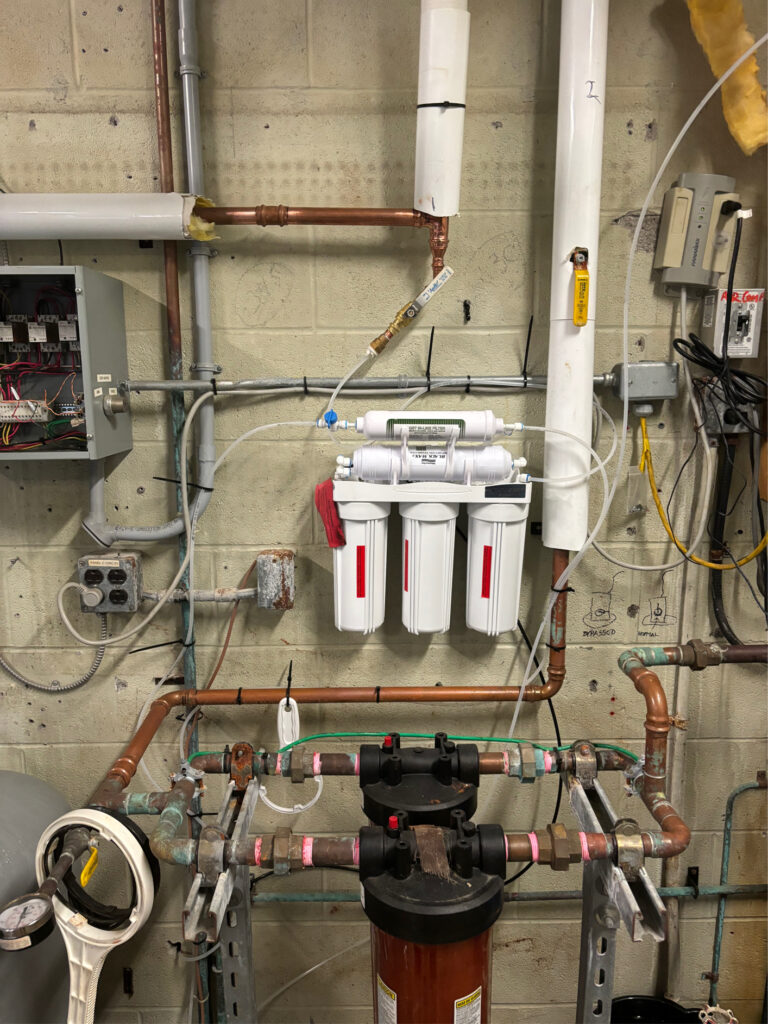
Most RO systems go under the kitchen sink. That’s the most common installation by far and it’s what most homeowners picture when they think of an RO system.
Here’s how it typically works. The filter unit and an expansion tank are installed inside the cabinet under your kitchen sink. The system connects to your cold water supply line and filters water into the expansion tank. From there, a dedicated RO faucet — drilled through your counter top — gives you a separate tap for drinking water only. Your regular kitchen tap runs unchanged. Your RO tap delivers filtered water on demand.
That dedicated faucet is the detail most homeowners don’t anticipate. It means a small hole drilled in your counter top for the RO tap. In most kitchens there’s already an unused pre-drilled hole from a soap dispenser or side sprayer that works perfectly. However if not, drilling into granite or stone counter tops requires care and the right equipment.
The other option — and one I’ve done in my own home — is installing the RO system in the basement. Because the system is further from the tap, a booster pump is required to push the filtered water up and maintain adequate pressure. However the advantage is flexibility. In my case I connected the system directly to my fridge so filtered RO water comes out of the fridge dispenser. No dedicated counter top faucet required.
RO systems naturally lose pressure as they filter water. The membrane that does the filtering restricts flow. As a result, without adequate water pressure going in, the flow coming out can be frustratingly slow.
If your home’s water pressure is already on the lower end — which is common in some older London neighbourhoods — a booster pump may be necessary to get water flowing at a rate that feels satisfying. Furthermore, if you’re installing the system in a basement or any location where the water needs to travel upward to reach the tap, a booster pump is typically required.
We assess your water pressure as part of every RO installation. If a booster pump is needed, we tell you before installation starts — not after.
Here’s something many homeowners don’t know until after they’ve had an RO system for a while. Because RO filters remove just about everything, the water that comes out is very pure — but it’s also flat. The minerals that give water its taste and mouthfeel are gone.
Some people love it. Others find it tastes empty compared to what they’re used to.
If minerals matter to you — either for taste or because you want the health benefits of naturally occurring calcium and magnesium in your drinking water — you can add a remineralization stage as the final filter before the water reaches your tap. This stage adds back a controlled amount of minerals after the RO membrane has done its work.
It’s an optional addition but one worth knowing about before you commit to a system. We can configure your RO installation to include remineralization if that’s what you want.
RO systems require filter changes on a regular schedule. Typically the pre-filters — sediment and carbon stages before the membrane — need replacing every 6 to 12 months depending on your water quality and usage. The RO membrane itself lasts 2 to 3 years under normal conditions. Furthermore the post-filter and remineralization cartridge if installed need periodic replacement as well.
Skipping filter changes reduces the system’s effectiveness and can shorten the membrane’s lifespan. We can set you up on a maintenance reminder schedule so you don’t have to track it yourself.
Contact Triton Home Service to discuss RO system options for your home
Is reverse osmosis worth it for London Ontario city water? It depends on your concerns. If taste and chlorine are your main issues, a quality carbon filter may be sufficient. If you’re concerned about lead — particularly in older homes with lead service lines — RO is highly effective. A water test tells you exactly what you’re dealing with before you invest in any system.
Where is an RO system installed in a home? Most commonly under the kitchen sink, connected to a dedicated RO faucet drilled into the counter top. Alternatively the system can be installed in a basement with a booster pump and connected directly to a fridge waterline or other point of use.
Do I need a booster pump for my RO system? Possibly. RO systems lose pressure as they filter water. If your home’s water pressure is low or the system is installed in a location where water needs to travel upward, a booster pump is typically required. We assess your pressure as part of every installation.
Does RO water lack minerals? Yes. RO membranes remove virtually everything including naturally occurring minerals. If you want minerals added back, a remineralization stage can be added as the final filter before your tap. This is an optional but popular addition.
How often do RO filters need to be changed? Pre-filters typically every 6 to 12 months. The RO membrane every 2 to 3 years. Post-filters and remineralization cartridges on a similar schedule. We can set you up on a reminder system so you don’t have to track it yourself.
Can an RO system connect to my fridge? Yes. This is a common configuration, particularly when the system is installed in a basement with a booster pump. Your fridge water and ice maker can be fed directly from the RO system giving you filtered drinking water throughout the kitchen.
There are a lot of RO systems on the market at a wide range of price points. Before you order one online or buy one at a big box store, have a conversation with a licensed plumber about what your water actually needs and what configuration makes sense for your home.
At Triton we start with questions — not recommendations. Because the right system depends on your water, your home, and what matters most to you about your drinking water.
Contact Triton Home Service to discuss water treatment options in London Ontario
For reference: Ontario Drinking Water Standards — Government of Ontario
Aron Oretan is a Licensed Red Seal Plumber and Steamfitter, UA Certified Instructor, and founder of Triton Home Service. With 26 years in the trade, licences in plumbing, steamfitting, and gas fitting, and five years teaching at Fanshawe College, he brings classroom expertise and field experience to every job in London, Woodstock, and Southwestern Ontario. Phone: 226-270-6424 | tritonservice.ca