
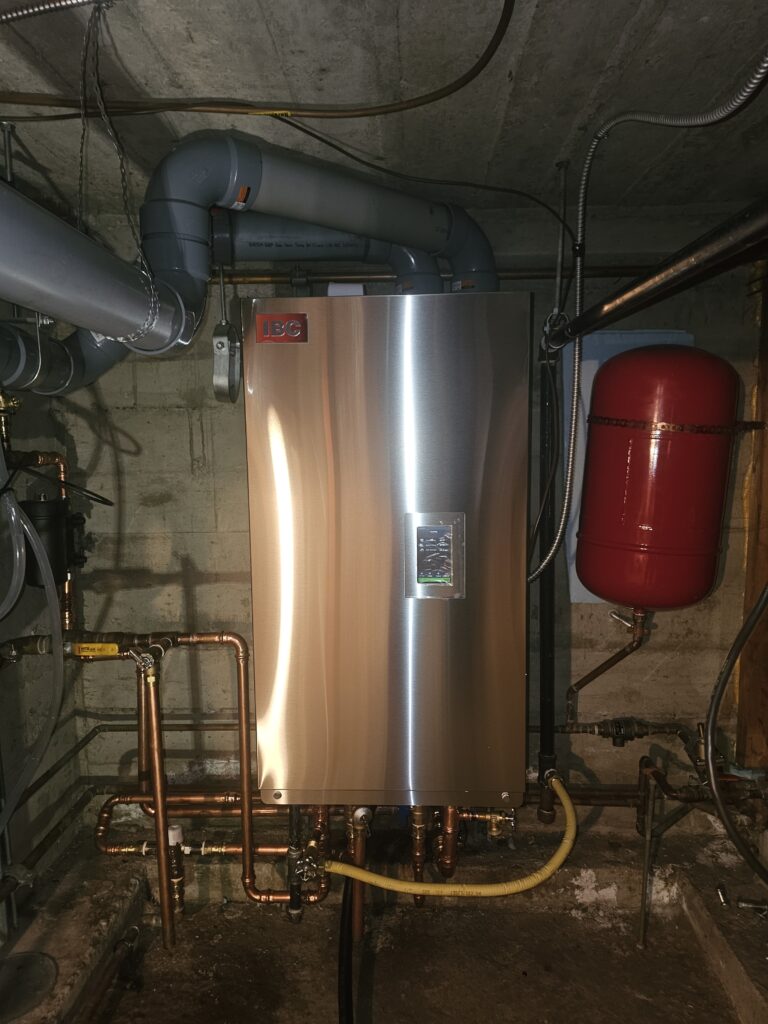
Combi Boiler London Ontario: Is It the Right Choice for Your Home?
A combi boiler London Ontario homeowners are choosing more frequently — and for good reason. One compact unit replaces both your boiler and your water heater, saves space, and can cut your installation cost significantly. However, a combi boiler isn’t the right solution for every home. At Triton Home Service, we’ve installed them across London and Southwestern Ontario for over a decade. Here’s what you need to know before you decide.
What Is a Combi Boiler?
A combi boiler is exactly what it sounds like — a combination boiler and water heater in a single unit. It heats your domestic hot water for showers, taps, and appliances. It also heats your hydronic system — radiators, in-floor tubing, or radiant panels — all from one compact wall-mounted unit.
The footprint is roughly the same as a standard tankless water heater. However, it does the job of two separate pieces of equipment. That matters in London homes where mechanical room space is tight.
Triton Field Note: “A combi boiler takes up the same wall space as a tankless water heater — but it also heats your entire hydronic system. For the right application, nothing beats it for efficiency of space and cost.” — Aron Oretan, Red Seal Plumber and Steamfitter, Triton Home Service
How Is a Combi Boiler Different From a Regular Boiler or Tankless Water Heater?
A standard boiler heats only your hydronic loop — your radiators or in-floor tubing. It does not heat your domestic hot water. Therefore, you need a separate water heater or indirect tank alongside it.
A tankless water heater heats your domestic hot water on demand. However, it is not designed or warranted for space heating. In fact, using a tankless water heater to heat your radiators or in-floor system voids the manufacturer warranty and shortens the lifespan of the equipment significantly.
A combi boiler is engineered specifically to do both. Your domestic water and your hydronic water never mix — they are heated separately within the same unit. As a result, you get full warranty coverage and a system built for exactly that dual application.
“Using a water heater for space heating voids the warranty and shortens the lifespan of the equipment. A combi boiler is made for exactly that application.” — Aron Oretan, Triton Home Service
The First Thing I Check Before Recommending a Combi Boiler
When a London homeowner calls about a combi boiler, I don’t start with brands or prices. I start with three questions.
First — what are we heating? The size of the space, the type of distribution system, and the condition of existing equipment all determine whether a combi boiler is the right fit or whether a separate boiler and indirect tank makes more sense.
Second — what shape is the existing system in? An aging distribution system with corroded radiators or failing zone valves changes the scope of the job significantly. Furthermore, replacing a heat source without addressing a failing system is money wasted.
Third — and most importantly — what is the water quality?
This is the question most contractors skip. It’s also the one that determines whether your combi boiler lasts five years or twenty-five.
Why Water Quality Can Make or Break Your Combi Boiler
Combi boilers and tankless water heaters share a common vulnerability — hard water. London Ontario sits in a region with moderately hard water, and many rural properties in Oxford County and Elgin County draw from wells with high mineral content.
When hard water runs through a combi boiler without proper treatment, calcium and mineral deposits build up inside the heat exchanger. Over time that buildup restricts flow, reduces efficiency, and ultimately destroys the unit. A boiler that should last twenty years can fail in five without the right water treatment in place.
Before I recommend or install any combi boiler, I verify the homeowner’s water treatment strategy. If there’s no water softener or the existing one isn’t performing, that gets addressed first. A combi boiler is a significant investment. Protecting it starts with the water going into it.
According to the Water Quality Association, hard water scale buildup can reduce water heater efficiency by up to 48% and dramatically shorten equipment lifespan — making water treatment one of the highest-return investments a homeowner can make alongside a new heating system.
For more on water treatment options in London and Southwestern Ontario, see our Water Softener London Ontario post.
When a Combi Boiler Is the Right Choice
A combi boiler performs best in specific applications. Furthermore, knowing when it fits saves you money and avoids a mismatched system.
Good candidates include:
- Apartments, condos, and duplexes where mechanical space is limited
- Homes with hydronic radiator systems needing a boiler and water heater replacement
- New builds where the designer wants to simplify the mechanical room
- Smaller homes where demand on domestic hot water is moderate
We installed two IBC combi boilers in a residential duplex in the Chelsea Green neighbourhood of London. Each unit heated the domestic hot water and the radiators for one apartment. Space inside each unit was tight. One combi boiler replaced what would have been a boiler plus a separate water heater in each suite. The result was a clean, compact mechanical installation with full manufacturer warranty and equipment designed for exactly that dual-purpose application.
When a Combi Boiler Is Not the Right Choice
Honesty matters more than a sale. Therefore, here is when I steer homeowners away from a combi boiler.
Poor water quality without a treatment plan. If the water is heavily mineralized and the homeowner isn’t willing to address it, a combi boiler will fail prematurely. In that case a different system configuration makes more sense.
Large or complex hydronic systems. Bigger homes with multiple zones and high BTU demand sometimes perform better with dedicated boilers — potentially multiple units in a lead-lag configuration — paired with a separate indirect water heater. As a result, the system can be staged and serviced independently.
High domestic hot water demand. Large families or homes with multiple bathrooms running simultaneously can exceed what a single combi unit delivers comfortably. An indirect tank paired with a dedicated boiler handles peak demand more reliably in those situations.
What Brands Does Triton Install?
For combi boilers I specify IBC boilers. They’re well-engineered, serviceable, and I’ve had consistent results with them on London jobs over many years.
For combi tanks — where the domestic water and hydronic water are handled in a tank configuration rather than a wall-mounted unit — I specify Bradford White. Same principle, different form factor, and Bradford White builds reliable equipment that holds up in Southwestern Ontario conditions.
Every specification starts with the system, not the brand. However, when the application fits, these are the units I trust.
What Does a Combi Boiler Installation Cost in London Ontario?
Every system is different. The condition of your existing distribution system, the age of your components, what can be reused, and what has reached end of life all affect the final number.
A realistic range for supply and install in London Ontario is $4,000 to $20,000. The wide range reflects how different each home’s situation is. A straightforward swap in a clean mechanical room sits toward the lower end. A full system overhaul with new distribution, zone valves, and controls moves toward the higher end.
The only way to give you an accurate number is a free in-home estimate. We look at the whole system before we quote anything.
For a full overview of our heating and plumbing services visit our Triton Home Service plumbing services page.
Book Your Free Combi Boiler Estimate
If you’re replacing an aging boiler, water heater, or both — a combi boiler may be the most efficient path forward. However, the right answer depends on your home, your water, and your system.
Call Triton Home Service at 226-270-5177 or book directly below. We’ll give you a straight answer and a written estimate.
Book your free in-home estimate
Frequently Asked Questions: Combi Boiler London Ontario
What is a combi boiler and how does it work? A combi boiler is a single unit that heats both your domestic hot water and your hydronic heating system. The two water supplies never mix. One compact unit replaces a separate boiler and water heater.
Is a combi boiler more efficient than a regular boiler? In the right application, yes. Eliminating a separate water heater reduces standby heat loss and simplifies the system. However, efficiency depends heavily on proper sizing, installation, and water quality.
How long does a combi boiler last? A properly installed and maintained combi boiler with good water quality can last 20 to 25 years. Poor water quality is the most common cause of premature failure.
Do I need a water softener with a combi boiler? In most London and Southwestern Ontario homes, yes. Hard water mineral buildup is the leading cause of combi boiler and tankless water heater failure. We verify water quality before every installation.
Can a combi boiler heat in-floor heating and domestic hot water at the same time? Yes. That is exactly what it is designed to do. The hydronic loop and domestic water are heated separately within the same unit without any cross-contamination.
What is the difference between a combi boiler and a combi tank? A combi boiler is a wall-mounted condensing unit — compact and high-efficiency. A combi tank performs the same dual function in a tank configuration. The right choice depends on your system size, space, and application.
Can I use a tankless water heater for space heating instead of a combi boiler? No. Using a tankless water heater for space heating voids the manufacturer warranty and shortens equipment lifespan. A combi boiler is engineered and warranted for both applications.
Who installs combi boilers in London Ontario? Triton Home Service installs and services combi boilers across London and Southwestern Ontario. Aron Oretan holds both a Red Seal Plumber licence and a Red Seal Steamfitter licence — one of the few contractors in the region fully licensed for hydronic heating systems.
Book your free combi boiler estimate with Triton Home Service
Reference: Water Quality Association — Scale Buildup and Water Heater Efficiency
Aron Oretan is a Licensed Red Seal Plumber and Steamfitter, UA Certified Instructor, and founder of Triton Home Service. With 26 years in the trade, licences in plumbing, steamfitting, and gas fitting, and five years teaching at Fanshawe College, he brings classroom expertise and field experience to every job in London, Woodstock, St. Thomas, and Southwestern Ontario. Phone: 226-270-5177 | tritonservice.ca