
In-Floor Heating London Ontario: What Every Homeowner Should Know
In-floor heating London Ontario homeowners are choosing more often than ever — and once you’ve lived with it, you never go back to forced air. At Triton Home Service, we’ve installed hydronic heating systems in new builds, renovations, three-season rooms, driveways, and garages across London and Southwestern Ontario. This is what 26 years in the trade and a Red Seal Steamfitter licence teaches you about doing it right.
What Is In-Floor Heating and How Does It Work?
In-floor heating uses hot water moving through tubing embedded in your floor to radiate heat upward into your living space. This is called a hydronic system. A boiler or combi unit heats the water, and that water circulates through loops of tubing laid under or inside your floor.
Forced air pushes hot air from a vent. Hydronic heat radiates from the floor up. That difference changes everything about how your home feels in winter.
Triton Field Note: “Forced air heats your ceiling first. Nobody sits on the ceiling. Hydronic heat starts at the floor — right where you live.” — Aron Oretan, Red Seal Plumber and Steamfitter, Triton Home Service
Why Hydronic Heat Is More Efficient Than Forced Air
Efficiency isn’t just about your gas bill. It’s about delivering the right amount of heat to the right place without waste. Hydronic systems do this better than forced air in three specific ways.
First, you control exactly how many BTUs go to each room. There are no cold corners and no rooms that overheat while others stay cold. Second, hydronic heat doesn’t disappear when you open a door. Forced air is gone the moment a door swings open. Hydronic heat is stored in the mass of your concrete slab or floor assembly. Close the door and the heat radiates back immediately. Third, heat stays low where you need it. Forced air rises straight to your ceiling. You heat twelve feet of air before you feel comfortable at floor level. Hydronic keeps warmth right where you live.
According to the Canadian Centre for Housing Technology, radiant floor heating systems can operate at efficiencies exceeding 90% when properly designed and installed — outperforming conventional forced air in both comfort and energy use.
What Can a Hydronic System Actually Heat?
This is where most homeowners are surprised. A properly designed hydronic system isn’t just about warm floors. Furthermore, it’s one of the most versatile heating platforms available to a London homeowner.
At Triton we’ve connected hydronic systems to:
- In-floor tubing in basements, main floors, and upper floors
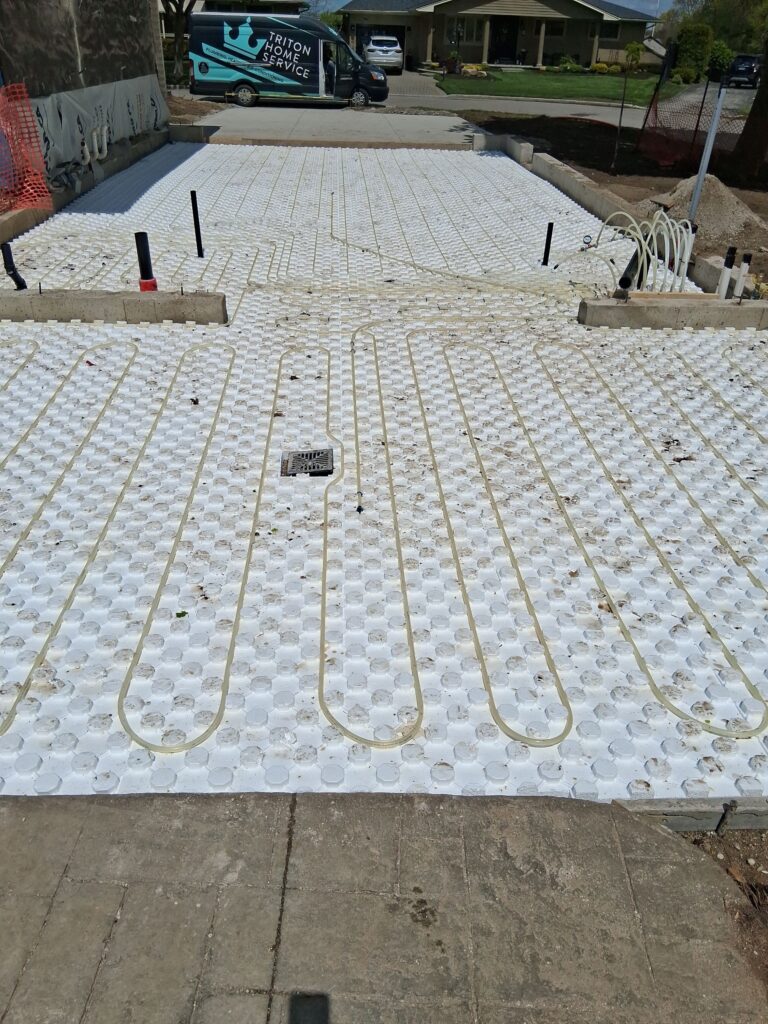
- snow-melt systems in driveways and walkways
- Towel warmers and heated towel bars
- Cast iron radiators and high-efficiency radiant panels
- Three-season rooms and enclosed patios
- Indirect water heaters
- Cooling systems that chill the slab just above the dew point
That last one surprises people. Newer buffer tank technology allows a hydronic system to assist with cooling by storing cold energy in your slab. This is emerging technology in Southwestern Ontario and a topic we’ll cover in a dedicated post soon.
How In-Floor Heating Is Installed: What the Job Actually Looks Like
Planning is everything with a hydronic system. In fact, this is the single most important thing I tell every homeowner who calls.
Basement and main floor installs start before the concrete is poured. Tubing is laid in a specific pattern, secured to the sub floor or re-bar grid, and concrete is poured over top. Once that floor is poured, the tubing is permanent. There’s no going back and adding it later without breaking up the slab.
Upper floor installs require an extra inch and a half of clearance for a lightweight concrete topper. That means your framing crew and your plumber need to be talking before a single board goes up. Therefore, hydronic heat needs to be in your construction plans from day one — not added as an afterthought when drywall is going up.
Renovations are possible. However, they require the right conditions and honest planning conversations upfront. If the floor is already poured and finishing, in-floor tubing may not be viable. In that case we can often achieve the same hydronic comfort with wall-mounted radiators or radiant panels — no slab work required.
“Hydronic heat is not usually a last-minute addition to your construction plans.” — Aron Oretan, Triton Home Service
Choosing the Right Boiler or Heat Source
There is no single right boiler for every job. As a Red Seal Steamfitter, I spec the heat source based on the specific system we’re building — not a brand preference or a supplier relationship.
The main options are:
Standard boilers heat only the hydronic loop. They’re straightforward and reliable for dedicated heating systems.
Combi boilers combine a tankless water heater and a boiler in one unit. Your domestic hot water and your hydronic water stay separate but share one heat source. These are efficient and space-saving for the right application.
Combi tanks work on the same principle as a combi boiler but in tank form. We used this setup on a three-season room install in London — the tank heated the homeowner’s domestic hot water and the glycol loop for their patio all in one unit.
Air-to-water heat pumps extract heat from outside air and transfer it into your hydronic water. As a result, they’re gaining traction in Ontario as an efficient, low-emission alternative to gas-fired boilers.
The system size, the square footage, the zones, and what you’re heating all determine which unit belongs in your mechanical room. That’s a conversation — not a catalogue selection.
Real London Job: The Three-Season Room That Changed How a Family Uses Their Home
One of my favourite installs was a three-season screened patio addition for a London homeowner. They wanted to use that space deep into fall and through mild winter days — not just in summer.
We ran a glycol loop instead of water. Glycol won’t freeze if the system shuts down, which matters for a space that isn’t always conditioned. We tied it into a combi tank that handled their domestic hot water and the patio loop together. The result was a space they could sit in comfortably on cold October and November days — outside enough to feel like outside, warm enough to stay for hours.
That’s what a properly designed hydronic system does. It solves problems that forced air simply can’t.
Is In-Floor Heating Right for Your London Home?
In-floor heating works in new builds and renovations alike. However, the planning window matters. The earlier we’re involved in your project, the more options you have.
Good candidates include:
- New home construction at any stage before concrete is poured
- Basement finishing projects before the slab goes in
- Additions and enclosed patios where glycol systems make sense
- Garages, shops, and heated driveways
- Homeowners replacing an aging forced air system who want lasting comfort
If you’re not sure whether your project qualifies, call us. We’ll give you a straight answer. Visit our plumbing and heating services page to see the full scope of what Triton installs across London and Southwestern Ontario.
Book Your In-Floor Heating Consultation
Hydronic systems require an experienced hand and a licence to match. As a Red Seal Plumber and Steamfitter with 26 years in the trade, I design and install systems that perform for decades.
Frequently Asked Questions: In-Floor Heating London Ontario
How much does in-floor heating cost in London Ontario? Every system is different. Cost depends on square footage, number of zones, heat source, and whether it’s a new build or renovation. Call Triton at 226-270-6424 for a site-specific quote.
Can in-floor heating be added to an existing home? Yes, in many cases. If the floor is already poured, we often install wall-mounted radiators or radiant panels to deliver the same hydronic comfort without breaking up the slab.
Is hydronic in-floor heating more efficient than forced air? Yes. Hydronic systems deliver heat directly to the living zone with less waste. They also retain heat in the thermal mass of the slab, so opening a door doesn’t empty the room of warmth the way forced air does.
How long does an in-floor heating system last? The tubing embedded in a concrete slab is rated to last 50 years or more when properly installed. The boiler or heat source has a typical lifespan of 15 to 25 years depending on the unit and maintenance.
Can a hydronic system also cool my home? Newer buffer tank technology allows hydronic systems to assist with cooling by chilling the slab just above the dew point. This is an emerging application in Southwestern Ontario that Triton is actively installing.
Do I need a special licence to install in-floor heating in Ontario? Yes. Hydronic heating falls under both plumbing and steamfitting trades in Ontario. Aron Oretan holds both a Red Seal Plumber licence and a Red Seal Steamfitter licence — one of the few contractors in London who is fully licensed for both.
What is glycol and why is it used in some systems? Glycol is an antifreeze fluid used in hydronic loops where freezing is a risk — three-season rooms, garages, or systems that may be shut down in winter. It protects the tubing and components from freeze damage without affecting performance.
Book your in-floor heating consultation with Triton Home Service
Reference: Canadian Centre for Housing Technology — Radiant Floor Heating Performance Study
Aron Oretan is a Licensed Red Seal Plumber and Steamfitter, UA Certified Instructor, and founder of Triton Home Service. With 26 years in the trade, licences in plumbing, steamfitting, and gas fitting, and five years teaching at Fanshawe College, he brings classroom expertise and field experience to every job in London, Woodstock, St. Thomas, and Southwestern Ontario. Phone: 226-270-6424 | tritonservice.ca