
I get asked about tankless water heaters almost every week. Homeowners in London call me for three main reasons: their old tank finally failed, they want to save space, or they think tankless will cut their utility bills in half. Two of those reasons are straightforward. The cost savings one takes some explaining.
I’ve installed tankless water heaters across London, St. Thomas, and Oxford County for over 26 years. I run one at my own house. My parents have one at their place and at their rental property too. So when I explain the real numbers to a customer, I’m not reading from a brochure. I’m telling you what I tell my own family.
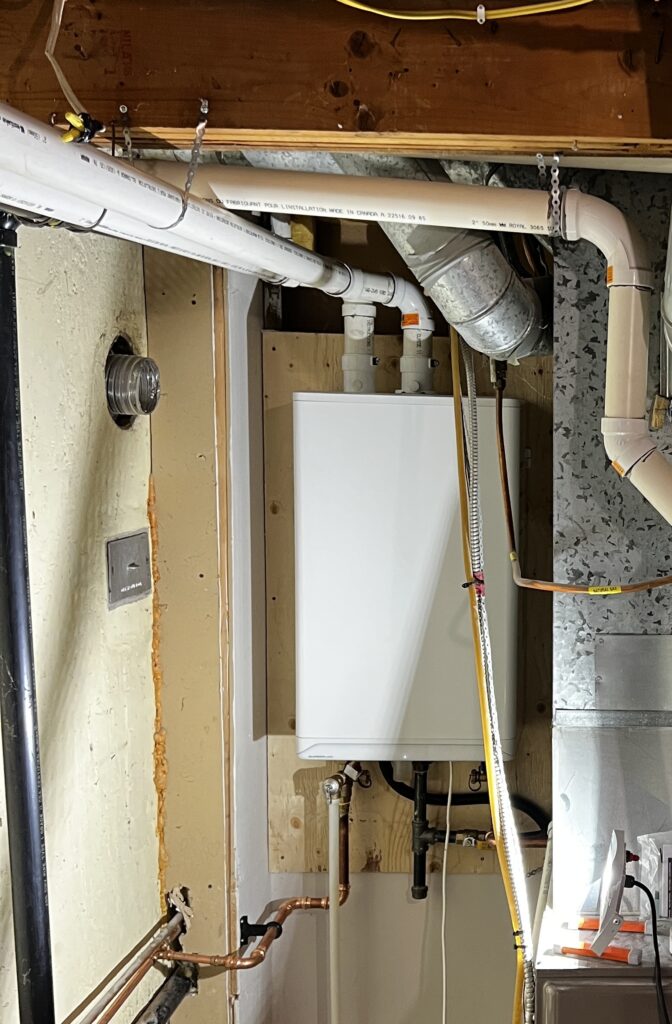
How a Tankless Water Heater Actually Saves You Money
Most homeowners think a tankless water heater uses less gas overall than a tank. That’s not quite right, and I want to be straight with you about it.
Here’s the real math. A standard 40-gallon tank water heater uses roughly 40,000 BTUs to keep that water hot around the clock, whether you’re using it or not. It sits there reheating itself all day while you’re at work, all night while you sleep. That’s called standby loss, and it’s where your gas bill quietly climbs.
A tankless unit doesn’t store any water, so it doesn’t have standby loss. It sits off, using zero gas, until you turn on a faucet. Then it fires up and heats water on demand. If you use 100,000 or 200,000 BTUs worth of hot water in a day, the tankless still uses roughly that same amount of energy to heat it. The savings come from the hours it spends off, not from using less energy per gallon.
So yes, a tankless water heater in London Ontario will lower your gas bill. But the real win isn’t the fuel savings alone. It’s what you get on top of it.
Unlimited Hot Water, As Long As You Respect the Limit
With a tank water heater, you eventually run out. Two showers and a load of laundry can leave the last person with lukewarm water because the tank can’t recover fast enough.
A tankless unit doesn’t have that ceiling in the same way. As long as you stay under its maximum output, it just keeps making hot water. You could run a faucet all day and never run out.
That “as long as” matters, and it’s the part some installers skip. Every tankless unit has a gallons-per-minute limit. Push past it with too many fixtures running at once, and the output temperature drops.
Why I Always Install a 199,000 BTU Unit in London
I don’t let customers talk me into a smaller tankless water heater to save a few hundred dollars upfront. I install 199,000 BTU units almost exclusively, and here’s why.
Southwestern Ontario groundwater runs cold, especially in winter. The colder your incoming water, the bigger the delta T, the temperature rise the unit has to produce to hit your target hot water temperature. A smaller unit that works fine in a milder climate can fall short here.
I also set honest expectations upfront. For a larger household, I’ll walk through the math with the homeowner: how many showers, dishwashers, and washing machines they might run at once, versus what the unit can deliver. If a big house is going to bump against that limit, I say so before the install, not after.
What a Tankless Water Heater Costs in London Ontario
Pricing depends heavily on what’s already at your house.
A straight swap, tankless to tankless or a simpler conversion, usually lands under $3,000. A brand-new install converting from a power-vented tank water heater typically runs $4,000 to $5,000, because we usually need to run a new vent pipe and upsize the gas line. Tankless units draw more gas at once than a tank does, so the existing gas line often isn’t big enough.
One thing that surprises people: tank and tankless equipment costs have moved much closer together over the last five years. Tanks have gotten more expensive due to steel and shipping costs, while tankless pricing has held roughly steady. The install itself is still more involved with a tankless, which is where most of the price difference now comes from.
Why I Won’t Install a Tank Water Heater in a New Build
If I’m putting a water heater into a new home, I go tankless every time. Beyond the space savings and efficiency, tankless units use sealed combustion, meaning the combustion chamber pulls its air from outside rather than the room. I consider natural draft tank water heaters more of a safety risk by comparison.
The building code in Ontario has been moving the same direction, phasing out power-vented units in favour of power direct vent and sealed combustion designs. Tankless water heaters have been ahead of that curve for years.
If your current water heater is aging or you’re planning a renovation, a licensed plumber can walk your specific hot water demands and help you size the right unit, rather than guessing.
Frequently Asked Questions
Does a tankless water heater really save money in Ontario?
Yes, but the savings come mainly from eliminating standby heat loss, the energy a tank wastes keeping water hot when nobody’s using it. According to Natural Resources Canada, ENERGY STAR certified tankless water heaters use about 30% less energy on average than storage tank models.
What size tankless water heater do I need for a London home?
It depends on your household’s peak hot water demand and our cold groundwater temperatures. I install 199,000 BTU units almost exclusively in this area to handle the winter delta T and give homeowners realistic simultaneous-use capacity.
How much does it cost to install a tankless water heater in London Ontario?
A like-for-like swap typically runs under $3,000. A new conversion from a power-vented tank, which usually needs a new vent and larger gas line, typically runs $4,000 to $5,000.
Can a tankless water heater run out of hot water?
Not the way a tank does. It won’t run dry, but if you exceed its gallons-per-minute rating by running too many fixtures at once, the output temperature will drop.
Is a tankless water heater safer than a tank water heater?
Tankless units use sealed combustion, drawing air from outside rather than the room, which I consider safer than an older natural draft tank. Ontario’s building code has been shifting toward this design for new installs.
Do I need a bigger gas line for a tankless water heater?
Often, yes, if you’re converting from a tank. Tankless units draw more gas at once to heat water on demand, so the existing line frequently needs to be up sized during a new install.
Ready to talk tankless for your home? Book an appointment with Triton Home Service or call 226-270-5177.
About the Author
Aron Oretan is the owner of Triton Home Service, a Red Seal Plumber and Red Seal Steamfitter with over 26 years in the trade. He holds the RSE designation and has spent five years teaching at Fanshawe College. Triton serves London, St. Thomas, and the surrounding Southwestern Ontario region with residential service, renovations, and ICI new construction